Why the office pod is redefining the workplace: space within the space
Published on: 13 January, 2026
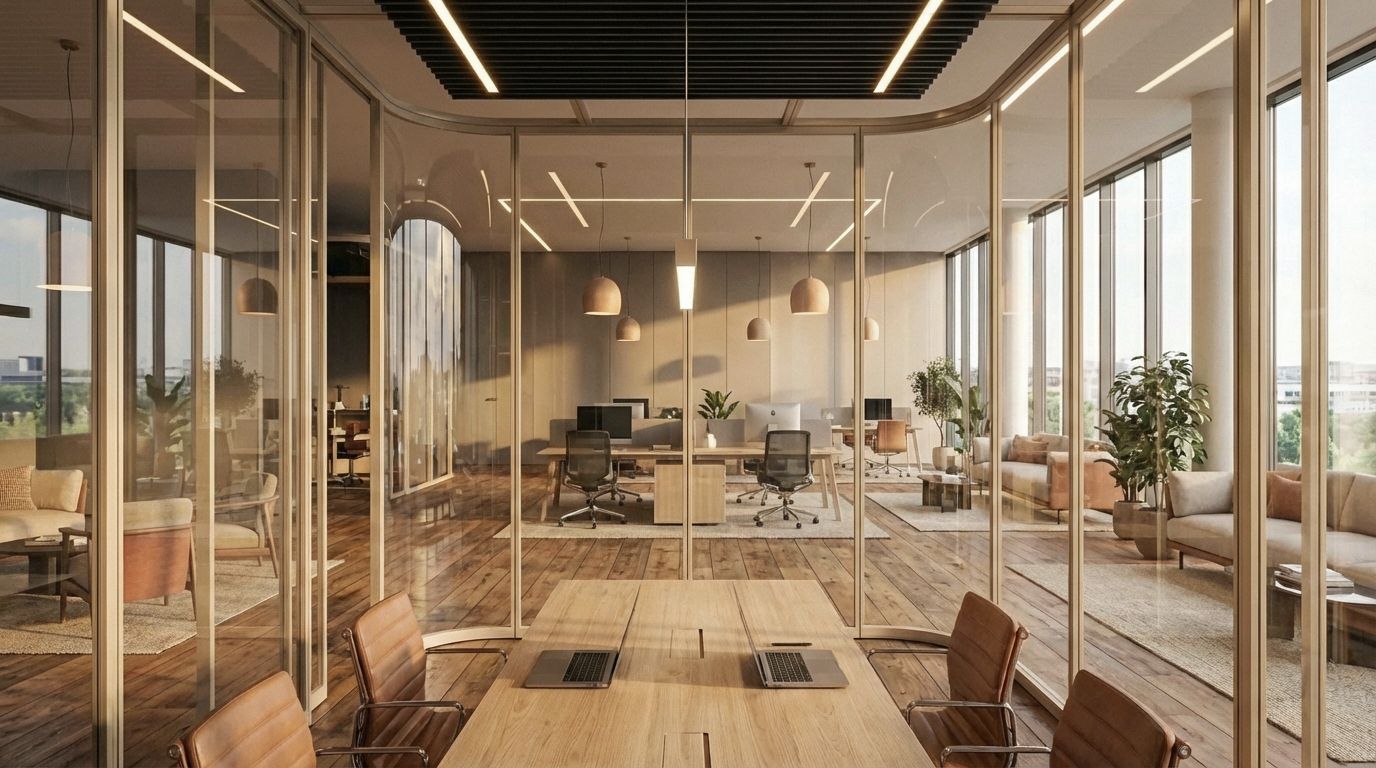
Why is the office pod becoming one of the most talked-about elements in contemporary workplace design?
Because today's office is no longer defined by rigid divisions, fixed hierarchies, or permanent walls. Instead, it is shaped by flexibility, hybrid behaviors, and the need to support different ways of working throughout the day. In this new logic, the office pod is not a separator, but a space within the space: an architectural tool that creates moments of privacy, focus, and acoustic comfort without breaking the openness of the workplace.
As organizations rethink how people use offices, the office pod has emerged as a response to a fundamental challenge: how to balance collaboration with concentration. Open-plan environments encourage interaction, but they often lack areas for calls, meetings, or individual focus. The office pod answers this need by introducing enclosed, yet flexible, environments that can be placed exactly where they are needed, without redesigning the entire layout.
At IOC project partners, we see the office pod not as a standalone product, but as part of a broader design strategy, one that integrates partition systems, furniture, and spatial planning into a coherent whole.
Office pod and the new logic of the hybrid office
The contemporary office is increasingly hybrid. It is no longer a place designed for one single activity, but a landscape of different zones supporting different tasks: collaboration, focus, informal exchange, virtual meetings, and moments of isolation when needed. Within this framework, the office pod plays a crucial role.
Rather than dividing space permanently, the office pod introduces temporary, adaptable boundaries. They create islands of privacy inside open environments, allowing people to move fluidly between shared and individual work modes. This approach reflects a broader cultural shift: offices are no longer about control and separation, but about choice and adaptability.
The office pod supports activities that require concentration and acoustic protection, such as video calls, confidential meetings, or focused work sessions. At the same time, they preserve visual continuity and natural light, maintaining the openness that defines modern workspaces. This balance is essential in environments where collaboration is encouraged, but uninterrupted focus is equally valued.
From a design perspective, the office pod also allows architects and planners to respond quickly to evolving needs. Instead of redesigning entire floors, pods, for IOC project partners, can be introduced, repositioned, or reconfigured over time. This makes them a strategic tool for companies that anticipate growth, change, or evolving work patterns.
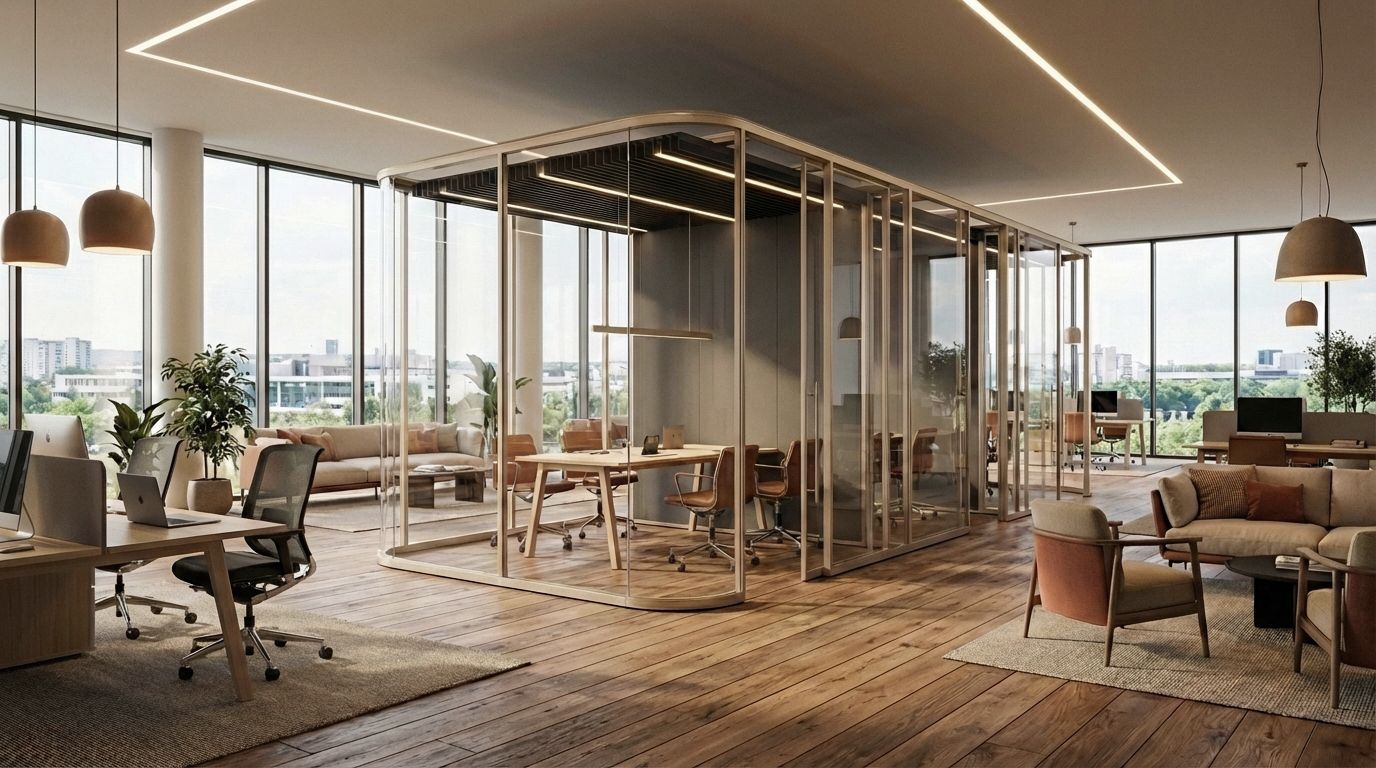
Ultralight: turning partition walls into an office pod
At the core of IOC's approach to the office pod is Ultralight, our highly flexible partition wall system. Ultralight was originally conceived as a modular architectural solution, but its adaptability has allowed it to evolve far beyond traditional partitioning.
Thanks to its structural logic and extensive profile system, makes it possible to design a freestanding office pod in different shapes, sizes, and configurations. These pods are not standard boxes, but tailor-made architectural elements that respond to specific spatial, and aesthetic requirements. An Ultralight office pod can be designed as single-user focus rooms, a small meeting pods, or enclosed collaborative spaces. Glass, solid, or hybrid panels allow designers to calibrate transparency and privacy, while integrated doors and technical solutions ensure comfort and usability. Because the system is modular, pods can also be adapted to complex layouts, irregular floor plans, or buildings with specific technical constraints.
What makes Ultralight particularly suited for office pod solutions is its ability to maintain architectural coherence. Pods do not feel like add-ons or temporary objects; they become an integral part of the space. This continuity is essential for projects where design quality and visual consistency are key values.
In this sense, the office pod becomes an extension of the partition wall philosophy: not a limitation, but a tool to shape space intelligently.
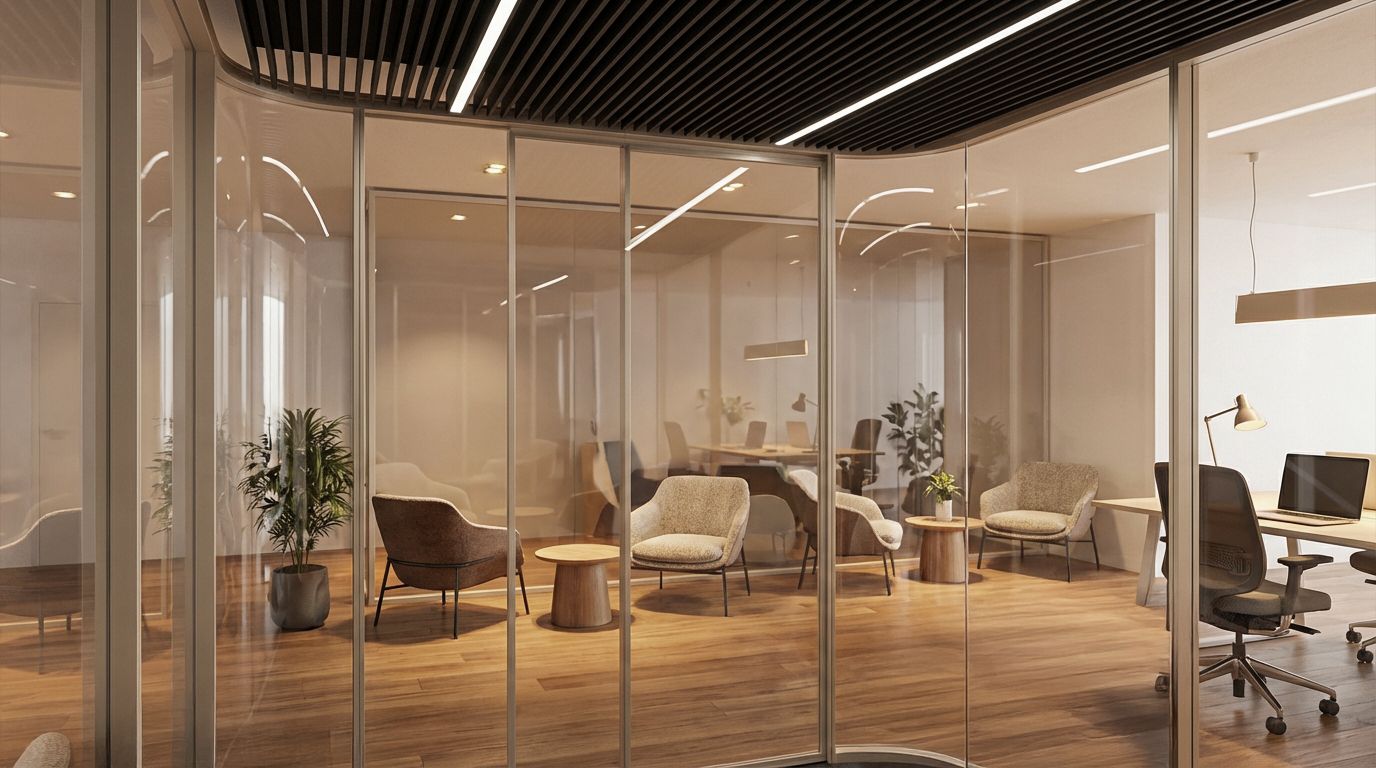
Office pod as a strategic design choice
Choosing to integrate an office pod into a workplace is not just a functional decision: it is a strategic one. It reflects an understanding of how people work today and how offices must adapt to support them.
An effective office pod offers more than acoustic isolation. It provides psychological comfort, a sense of control over one's environment, and the freedom to choose where and how to work. In hybrid offices, where presence and remote collaboration coexist, pods become essential infrastructure.
From a long-term perspective, an office pod also contribute to sustainability and adaptability. Modular systems like Ultralight allow spaces to evolve without wasteful demolition, while flexible layouts reduce the need for constant renovation. Pods can be reconfigured, reused, or relocated as organizational needs change.
Ultimately, the office pod represents a shift in mindset: from designing offices as fixed compositions to designing them as living systems. At IOC project partners, we believe that this approach, based on flexibility, listening, and architectural clarity, is the key to creating workplaces that remain relevant over time.
With Ultralight's modular partition system with furniture concepts like Monforte, we transform the office pod into more than an enclosure. It becomes a space within the space: adaptable, human-centered, and deeply connected to the way people work today.